
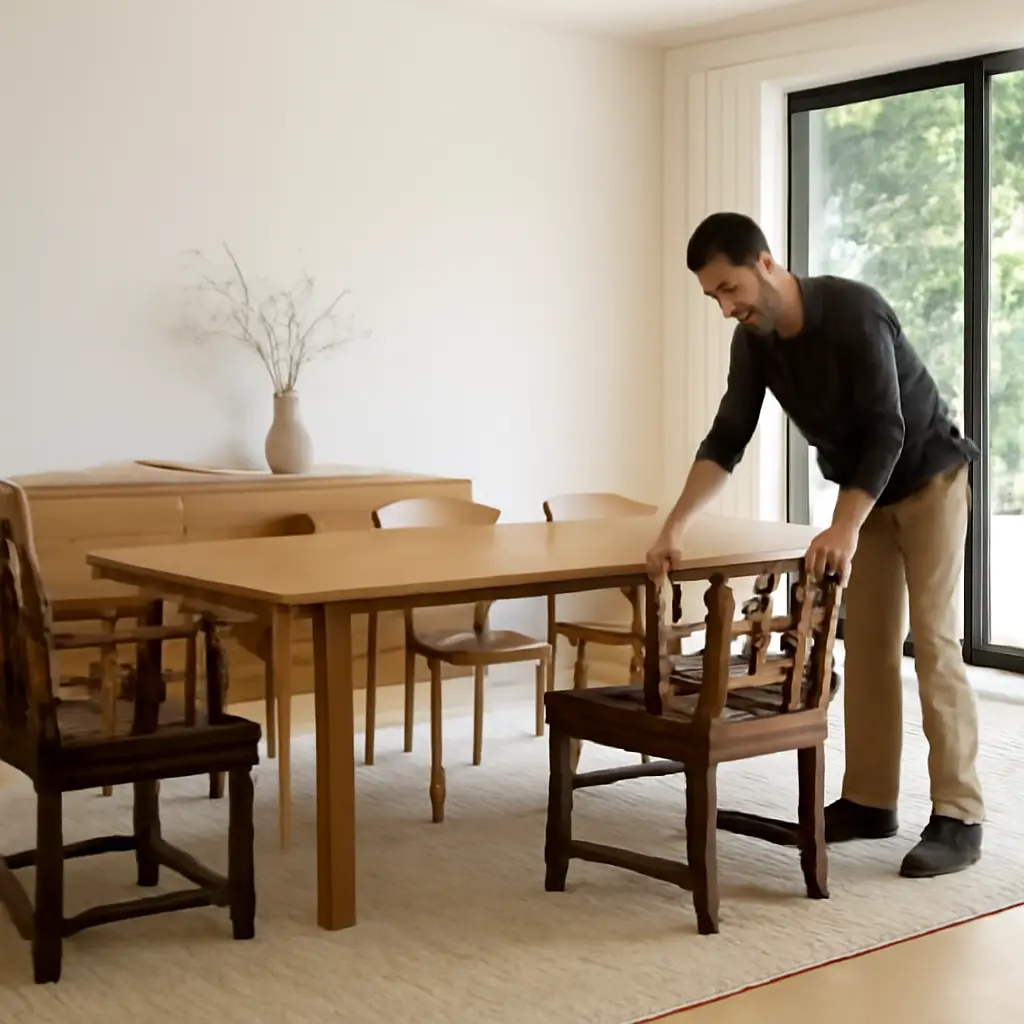
Antique Asian chairs can bring age, craftsmanship, and visual rhythm to a dining room without making it feel like a gallery. The key is to treat them as working furniture: mix a few distinctive chairs with comfortable, contemporary pieces, repeat colors and materials elsewhere in the room, and leave enough negative space for the antiques to feel at home. The approach also respects the scale of the collection: the U.S. Census Bureau counted more than 128 million occupied households in 2023, but a dining room’s character comes from thoughtful choices, not the number of period pieces in it.
Pairing Antique Asian Chairs With a Modern Dining Room
“Antique Asian chairs” is a broad design description, not a single historical style. It can refer to Chinese horseshoe-back or yoke-back chairs, Japanese forms such as the low zaisu seat, and chairs made in other Asian traditions or for export markets. Their woods, proportions, joinery, finishes, and original uses differ, so the first step is to identify what you own rather than treating every piece as interchangeable décor.
For a collected rather than museum-like room, preserve each chair’s individual character while making the overall arrangement feel intentional. A useful starting point is one or two antique chairs at the ends of a contemporary dining table, with simpler chairs along the sides. From there, connect the pieces through a shared detail—such as a dark wood tone, a warm metal, or a repeated upholstery color—and let the rest of the room remain comparatively relaxed.
Identify the chair’s form, origin, and condition
A horseshoe-back chair has a curved, continuous-looking back and arms, while many yoke-back chairs have a straighter top rail with projecting ends. These are recognizable Chinese furniture forms, but a silhouette alone cannot establish a chair’s age, exact origin, or authenticity. Construction, materials, wear, repairs, and provenance all matter. The Metropolitan Museum of Art’s collection records, for example, place Chinese furniture within a varied history of regional materials and forms rather than one uniform category.
Before putting a chair into daily service, check for loose joints, unstable legs, splits, old repairs, and fragile finishes. If its history or value is uncertain, ask a qualified furniture conservator or appraiser to assess it; avoid aggressive cleaning or refinishing until you understand the surface. An antique that is structurally sound can be part of everyday dining, but a fragile or rare example may be better used as an occasional seat or visual accent.
Use a small number as focal points
A focal-point arrangement gives an unusual chair enough space to register without turning the entire dining room into a period display. Try two matching antiques at the heads of a rectangular table, or place one distinctive chair beside a more restrained set. If you have several antiques, begin with the strongest pair and store or display the rest elsewhere rather than arranging every piece in one room.
This approach also makes the room easier to use. Keep the main passage around the table clear, and check that chairs can be pulled back without striking walls or cabinetry. Measure the seat height against the table and consider arm clearance: a beautiful chair that cannot slide beneath the table may work better at the head, where its arms have more room.
Mix Antique Asian Chairs With Contemporary Furniture
Mixing styles means combining furniture from different periods or design traditions while giving the pieces a shared visual relationship. In this room, the antique chairs can supply ornament and patina, while a simple table, contemporary lighting, and unfussy textiles provide contrast. The aim is not to disguise the chairs’ origins, but to keep the contrast from becoming a collection of unrelated statements.
A useful bridge is repetition. Repeat a color from the chairs in a rug or artwork, echo their wood tone in a frame, or pair carved details with a quieter surface nearby. The repeated element should be subtle; matching every finish can make the room feel staged, while a few related notes help different eras coexist.
Balance silhouette, scale, and visual weight
Visual weight is the sense that a piece feels substantial because of its shape, color, material, or detailing. A dark, carved chair can look heavier than a slim modern chair even if the two have similar dimensions. Balance that weight with an uncomplicated table, open space beneath the tabletop, or lighter elements elsewhere in the room.
Compare chair height and back shape before buying or rearranging. A tall, curved back can stand out against a low, rectilinear table; that contrast can be appealing if it is repeated or contained. If the chairs vary greatly in height, width, or arm shape, use a consistent table and restrained palette to keep the differences from becoming visually noisy.
Coordinate materials without matching everything
Material coordination connects objects through texture and finish rather than identical sets. Antique chairs may be made from hardwoods such as elm, rosewood, or other regional timber, while a contemporary table could be oak, painted wood, stone, or metal. Because wood species and old finishes can be difficult to identify by sight, coordinate by perceived warmth, darkness, and sheen instead of assuming two woods should match exactly.
For instance, a warm-toned antique can sit comfortably beside a pale oak table if the room includes a bridge such as a woven rug, a wood-framed print, or a softly colored table runner. Conversely, several dark pieces can feel less formal when paired with natural linen, matte ceramics, and daylight. These combinations preserve contrast while giving the eye a route through the room.
Add comfort with reversible, low-impact details
Comfort can be improved without permanently changing an antique. Use removable seat cushions in a durable fabric, ensuring that ties or fasteners do not rub against delicate finishes. Linen, cotton, or wool blends can soften the formality of dark wood; a solid color or small-scale pattern usually lets carved or curved details remain visible.
For upholstery or structural alterations, consult a conservator or experienced furniture professional, especially if the chair has collectible value. Avoid attaching modern hardware, drilling into original wood, or applying coatings that cannot be reversed. A removable cushion is a practical styling choice; an irreversible alteration can affect both the chair’s condition and its future care.
Style Antique Asian Chairs for Everyday Dining
Everyday styling distinguishes a lived-in dining room from a display setting. A clear tabletop, usable lighting, washable textiles, and a mix of comfortable seating make the antiques feel integrated into daily routines. The International Organization for Standardization’s ISO 7173 standard provides methods for assessing the strength and durability of chairs, a reminder that appearance alone does not establish whether a chair is suitable for frequent use. An antique should be evaluated individually rather than assumed to meet modern performance expectations.
If guests use the chairs regularly, test them in the actual dining arrangement: sit in them, pull them out, and check for wobble and clearance. Provide comfortable alternative seating if an antique is too delicate, too low, or uncomfortable for a long meal. Function is not a compromise to good design; it is what makes the room feel welcoming rather than untouchable.
Choose a table, rug, and lighting that let the chairs breathe
A plain table is often the simplest partner for chairs with prominent curves, carving, or inlay. A rug can define the dining zone and add softness, but it should be large enough that chair legs remain on it as chairs move. A pendant or chandelier can provide a visual center above the table; choose a shape and finish that relate to the room without imitating the antiques’ ornament.
A helpful planning image is a floor plan that marks the table, chair pull-back area, rug edge, and walking path. This makes practical conflicts visible before furniture is moved. If a rug catches chair legs or the light fixture crowds the chair backs, revise the layout rather than treating those issues as styling details.
Use art and accessories as context, not a themed backdrop
Art and accessories can acknowledge an antique chair’s cultural context, but a room does not need to become a themed tableau. A contemporary painting, local craft, or family photograph can sit alongside the chairs if the scale and palette work together. Avoid presenting unrelated Asian objects as interchangeable accents; objects from different countries, periods, and traditions have distinct histories.
A restrained arrangement is often more effective than filling shelves with decorative objects. One ceramic vessel, a considered artwork, or a single textile can establish a connection while leaving the chairs as furniture rather than exhibits. For provenance and cultural interpretation, museum collection notes and reputable scholarly references are more reliable than generalized décor labels.
Protect finishes during regular use
Care begins with prevention. Keep chairs away from direct, intense sunlight and heat sources, which can contribute to fading, drying, or finish changes. Lift rather than drag them across flooring, and use suitable floor protectors only after checking that their material will not mark or react with the chair legs. Clean spills promptly with a soft, lightly damp cloth, then dry the surface; avoid household sprays and abrasive cleaners unless a conservator recommends them.
For valuable furniture, the Canadian Conservation Institute’s preventive-conservation guidance emphasizes managing environmental risks and handling objects carefully. Its general conservation principles are useful, but specific treatment should reflect the chair’s materials and condition. If a finish is flaking, a joint is loose, or the wood shows active damage, pause routine use and seek professional advice.
A Practical Example: Two Antique Chairs at the Table Ends
Consider a dining room with a modern rectangular oak table, four simple side chairs, and two antique Chinese horseshoe-back chairs. Place the antiques at the table ends, where their curved silhouettes can be seen clearly. Add a neutral rug sized for chair movement, a contemporary pendant, and one color from the chair cushions in a nearby artwork. The result is a room in which the antiques are prominent but not isolated.
If the chairs are unstable or uncomfortable, keep them at the ends as occasional seats and use the side chairs for daily meals. If they are sound and comfortable, rotate seating as appropriate and use removable cushions. In either case, the layout makes the antiques part of the room’s life while respecting their condition and history.
Conclusion: Make the Antiques Part of the Room
A dining room feels collected, not museum-like, when antique Asian chairs are understood as individual objects, balanced with contemporary furniture, and arranged for real use. Identify each chair’s form and condition; use a small number as focal points; connect styles through color, material, and scale; and protect fragile finishes with reversible, informed care. Start by measuring your table and circulation space, then test one arrangement before making permanent changes. For further research, consult museum collection records and a qualified conservator or appraiser when questions of provenance, condition, or treatment arise.
Sources: U.S. Census Bureau, American Community Survey 2023, Selected Housing Characteristics, https://data.census.gov/table/ACSDP1Y2023.DP04; The Metropolitan Museum of Art, Collection Online, https://www.metmuseum.org/art/collection; International Organization for Standardization, ISO 7173:2023, Furniture—Chairs and stools—Determination of strength and durability, https://www.iso.org/standard/80697.html; Canadian Conservation Institute, Preventive Conservation and Care of Collections, https://www.canada.ca/en/conservation-institute/services/preventive-conservation.html