
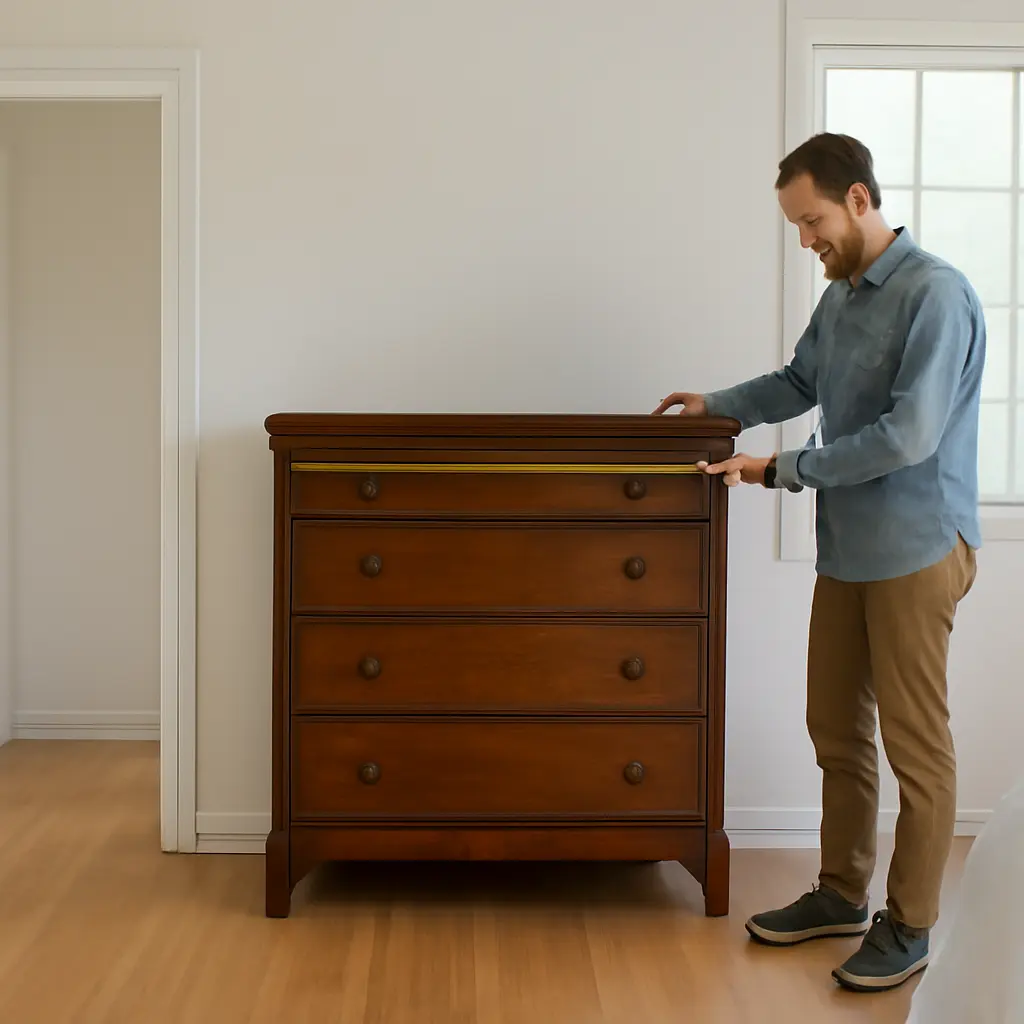
An antique dresser is a storage piece valued for its age, materials, construction, design, and history—but age alone cannot tell you whether it will work in your home. Scale matters more: measure the room, doorway, stairs, and intended use before comparing styles or dates. The U.S. National Park Service’s museum guidance treats size, condition, materials, and construction as central considerations in documenting and caring for historic objects; for a shopper, those same practical checks help prevent an attractive but unusable purchase. This guide explains how to judge dresser scale, match dimensions to a room, assess drawers and construction, and verify age and condition.
Matching antique dresser scale to the room
Scale is the relationship between a dresser’s overall dimensions and the space, furniture, and circulation around it. It includes height, width, depth, visual mass, and how much room remains for people to move and drawers to open. Interior-design guidance commonly treats circulation as a functional part of room planning: a piece should not obstruct doors, walkways, or access to other furnishings. The right dresser is therefore not simply the oldest or rarest one; it is a piece whose physical and visual proportions suit its destination.
Measure the complete route and footprint
A dresser’s footprint is the floor area it occupies, while its delivery route includes every doorway, hallway, stair, and turn it must pass through. Measure the intended wall and note baseboards, outlets, radiators, door swings, and nearby furniture. Then measure the narrowest point on the route, not just the front door. Record the dresser’s width, height, and depth, including projecting moldings, handles, and feet. A paper or painter’s-tape outline on the floor can make the footprint easier to visualize before purchase.
Drawer clearance matters too. Pull each drawer fully out, or estimate its extension, and make sure it will not strike a bed, door, or walkway. For online listings, ask the seller to confirm dimensions and whether removable mirrors, feet, or hardware change the measurements. A tape measure and a written route check are more dependable than judging scale from photographs, where camera angles can distort apparent size.
Match height and visual mass to the room
Visual mass is the impression of how large or heavy an object looks, which can differ from its measured footprint. A tall chest may occupy little floor space but dominate a low-ceilinged room; a broad, low dresser may feel calmer beneath a window but overwhelm a narrow wall. Compare the dresser’s height with nearby furniture and architectural features, and consider whether a mirror or raised back adds visual height. Leave enough surrounding space for the piece to read as furniture rather than as a wall-to-wall obstruction.
The same principle applies to style. A substantial, dark case can visually outweigh a room filled with light, slender furniture, even if its dimensions technically fit. Conversely, a compact dresser may look insignificant against a large bed or high ceiling. These are proportional judgments rather than fixed rules, so evaluate the piece in the actual room context whenever possible.
Evaluating antique dresser types by scale and use
“Antique dresser” is often used broadly in shops and listings, but the term can refer to different forms: a low chest of drawers, a tall chest, a dressing table with a mirror, or a washstand adapted for storage. These hyponyms—specific types within the broader dresser category—vary in height, depth, and function. Compare the type with your storage needs and available space before becoming attached to a particular period or finish.
Low chests and wide dressers
A low chest is a relatively broad, low case with drawers, often used for folded clothing or linens. Its top can also provide display or everyday landing space, but that use should not be assumed if the surface is fragile or unstable. Measure the wall width and leave room for adjacent furniture, then check that the dresser’s depth does not intrude into a walkway. A wide case can offer substantial storage while keeping its overall height modest.
Tall chests and highboys
A tall chest uses vertical space, often with drawers stacked in a narrow footprint. “Highboy” is a historical furniture form generally associated with a tall chest raised on legs or a lower case; sellers may use the word less precisely, so inspect the actual construction and dimensions. Tall pieces can suit small floor areas, but check ceiling height, stability, access to upper drawers, and the route needed to bring the case into the room. A high center of gravity makes secure placement especially important in homes with children or pets.
Dressing tables and mirrored forms
A dressing table combines storage with a surface and, in some examples, a mirror. Its full height may be determined by the mirror frame rather than the case, and its drawers or knee space may affect how it fits beside a bed or chair. Measure the assembled piece and identify any detachable mirror or supports. If the mirror is original or delicate, ask how it is attached and whether transport requires professional handling.
Checking construction, condition, and age
Once a dresser fits the space, assess whether it is sound and whether its age and description are credible. The National Park Service’s museum-conservation guidance emphasizes examining an object’s materials, construction, condition, and history as part of responsible care. For buyers, that means looking beyond a seller’s period label: joinery, wood, hardware, repairs, and finish can provide clues, but no single feature proves a date.
Inspect the case and drawer construction
Check that the case sits level and does not rack or wobble. Look for loose joints, cracks, water marks, insect damage, missing veneer, and evidence of structural repair. Open every drawer: it should move without excessive force, and its bottom should not sag or pull free. Dovetail joints, where interlocking pins and tails connect drawer sides, can be evidence of traditional hand or machine construction, but their presence alone does not establish a precise age. Machine-cut dovetails have been used for generations, and later furniture may imitate earlier details.
Treat age claims as claims to verify
In the United States, the Federal Trade Commission’s Guides for the Jewelry, Precious Metals, and Pewter Industries state that an article represented as “antique” should be at least 100 years old. That rule applies to the FTC guide’s covered marketing context and should not be mistaken for a universal dating test for every furniture listing or jurisdiction. Ask what evidence supports a date—such as documented ownership, maker’s marks, construction details, or a reputable appraisal—and distinguish an old piece from a reproduction or a later piece made in an earlier style.
Consider repairs, finish, and safe use
A repaired dresser is not automatically a poor purchase, but the quality and location of repairs matter. Ask whether the finish is original, refinished, or partly replaced, and whether drawers, feet, mirrors, or hardware have been changed. For a piece that will hold heavy items, verify that the case and drawer supports are stable. If the dresser is tall, anchor it to the wall using suitable hardware; the U.S. Consumer Product Safety Commission recommends anchoring furniture to help prevent tip-over injuries. Do not assume that an antique’s original design includes modern safety features.
A practical comparison before buying
A simple comparison can keep age and appearance from overshadowing fit and function. Record measurements, condition, storage capacity, delivery constraints, and the evidence behind the seller’s description. The table below is a planning aid, not a substitute for measuring the actual piece.
| Check | What to record | Why it matters |
|---|---|---|
| Room fit | Width, height, depth, drawer clearance, nearby obstacles | Prevents blocked circulation and unusable drawers |
| Delivery route | Narrowest doorway, stair turns, hallway clearance | Confirms the dresser can reach its destination |
| Condition | Joint stability, drawer movement, veneer, finish, repairs | Reveals likely repair needs and functional limitations |
| Provenance and age | Marks, documentation, seller’s basis for dating | Helps distinguish documented history from an unsupported label |
For example, imagine choosing between a narrow, tall chest with uncertain repairs and a wider, lower dresser with smoothly operating drawers and verified dimensions. If the room has low ceilings and ample wall width, the lower piece may be the more practical choice even if the tall chest appears older. The example illustrates the central point: use, fit, condition, and evidence should be weighed together rather than allowing age to decide the purchase by itself.
Conclusion: choose fit before fascination with age
Scale determines whether an antique dresser can enter the home, fit its room, and serve its intended purpose. Start by measuring the case, delivery route, and drawer clearance; compare the dresser’s visual mass and type with the room; then inspect construction, condition, safety, and the evidence supporting its age. Historical value can add meaning, but an age claim cannot compensate for poor fit or unsound drawers. Before buying, make a measurement sheet, ask the seller targeted questions, and consult a qualified furniture conservator or appraiser when authenticity or significant repairs affect the decision.
Sources: National Park Service, Museum Handbook, Part I: Museum Collections, https://www.nps.gov/museum/publications/MHI/CHAPTER1.pdf; Federal Trade Commission, Guides for the Jewelry, Precious Metals, and Pewter Industries, https://www.ecfr.gov/current/title-16/chapter-I/subchapter-B/part-23; U.S. Consumer Product Safety Commission, Anchor It!, https://www.anchorit.gov/