
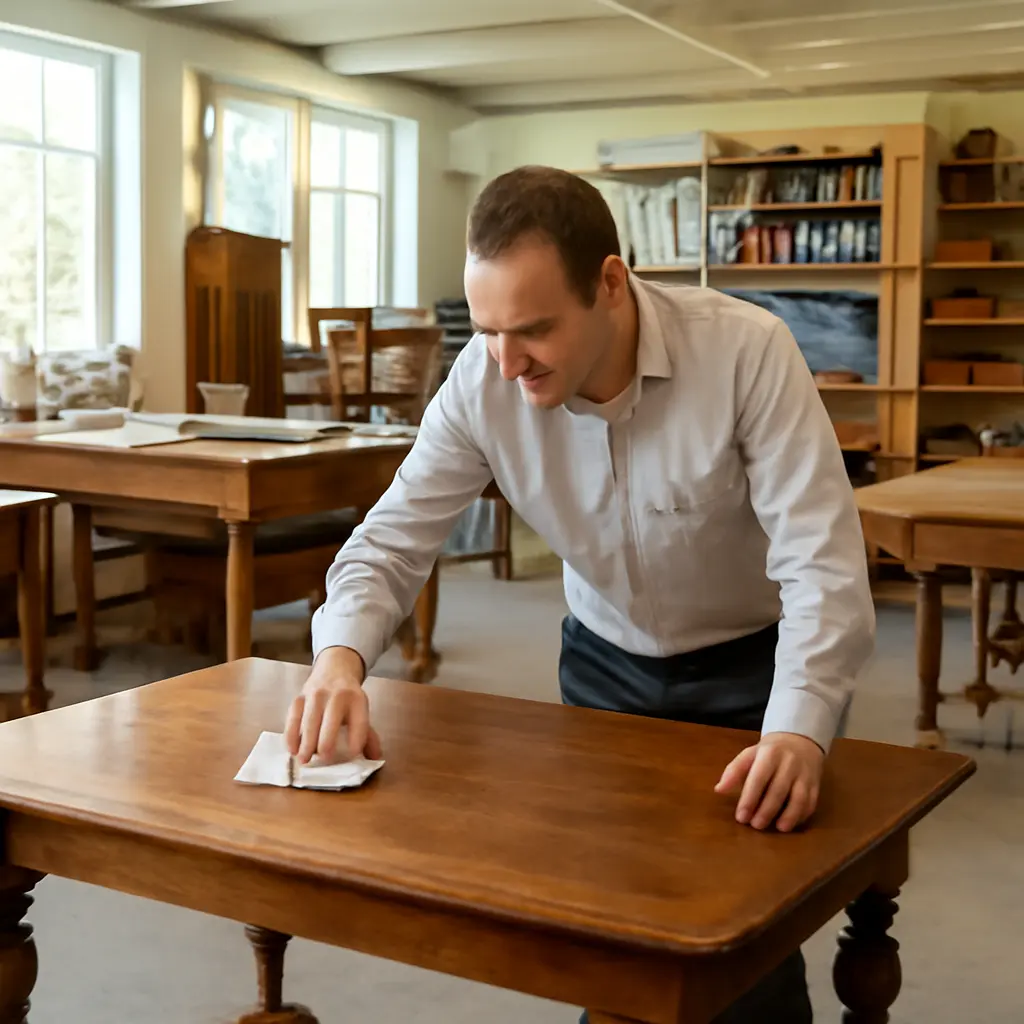
An antique tabletop is the horizontal surface of an older table, often made from solid wood, veneer, stone, or a combination of materials. The mistakes that quietly ruin one are usually ordinary habits: using the wrong cleaner, leaving moisture or heat in place, polishing too often, or attempting repairs without identifying the finish. The risks are real but preventable: the National Park Service notes that wood responds to changes in relative humidity by swelling and shrinking, while conservation guidance from the Smithsonian Institution favors stable conditions and gentle, minimal intervention. Understanding how finishes, moisture, heat, sunlight, and cleaning interact helps preserve a table’s appearance, construction, and historical evidence.
Preventive care protects antique tabletop finishes and surfaces
Preventive care means reducing exposure to the conditions and treatments that can damage an object before repairs become necessary. The Smithsonian Museum Conservation Institute describes preventive conservation as controlling an object’s environment and handling to slow deterioration. For an antique tabletop, the practical priorities are steady indoor humidity, protection from direct sun and hot or wet objects, and cleaning that does not strip or soften the finish.
An antique table is not automatically fragile, but its surface may be more vulnerable than a modern factory finish. Age, prior repairs, thin veneer, historic coatings, and earlier cleaning can all affect how it responds. Because appearance alone cannot reliably identify every finish, treat uncertainty as a reason to test and proceed cautiously—not as an invitation to try stronger products.
Misidentifying the finish leads to avoidable damage
A finish is the protective or decorative coating applied over wood. Antique furniture may have shellac, varnish, lacquer, oil, wax, or later refinishing; some surfaces also include painted decoration, gilding, or repairs. These materials react differently to solvents and moisture. For example, alcohol can damage shellac, while aggressive solvents may soften other coatings or dissolve later touch-ups.
Do not use an online “finish test” on a visible area of a valuable table. A test involving alcohol, acetone, or scratching can permanently change the surface. The American Institute for Conservation recommends consulting a qualified conservator for treatment questions. If the finish is cloudy, sticky, flaking, or unusually uneven, document it and seek professional advice before attempting restoration.
Over-polishing can build residue and obscure the surface
Polishing is the application of a product to improve gloss or appearance; it is not the same as cleaning or conserving. Repeated use of waxes, silicone-containing sprays, or oily polishes can leave layers of residue, attract dust, complicate future treatment, and make the surface look smeared or dull. A shine is not proof that a finish is healthy.
Use polish only when its suitability is established, and follow the product instructions sparingly. For routine care, remove loose dust with a clean, soft cloth. Avoid rubbing hard: grit caught in the cloth can act like an abrasive and leave fine scratches. If a surface has accumulated a cloudy or tacky film, do not try to remove it with household solvents; the deposits may be interacting with the original finish.
Moisture and heat quietly damage antique tabletops
Moisture damage includes rings, white haze, swelling, lifting veneer, and stains; heat damage can include finish cracks, discoloration, and weakened adhesives. The U.S. National Park Service explains that wood exchanges moisture with the surrounding air and changes dimension as its moisture content shifts. Repeated swings can stress joints, veneers, and coatings, especially when a table is exposed to heating vents, radiators, fireplaces, or damp rooms.
A tabletop can be harmed by a single spill or hot dish, but slow exposure matters too. Water that reaches a seam or damaged finish can swell wood or weaken adhesive, while a hot object may leave a mark even if it is removed quickly. The safest approach is to use barriers and deal with accidents promptly without scrubbing or applying untested remedies.
Leaving spills, wet objects, and condensation on the surface
A water ring is a pale or dark mark created when moisture interacts with a finish or penetrates the wood. A white mark may indicate moisture trapped in or beneath a coating; a dark mark can suggest that liquid has reached the wood itself. The appearance alone does not establish the cause or the safest treatment.
Use coasters, placemats, and dry trays, and wipe spills promptly with a soft, absorbent cloth. Do not leave flower vases, damp cloths, or cold glasses directly on the tabletop. Avoid folk remedies such as toothpaste, baking soda, mayonnaise, or an iron-and-cloth treatment: they can abrade, stain, or soften a finish and may turn a limited mark into a larger repair.
Placing hot cookware or appliances directly on the tabletop
Heat damage occurs when a hot object transfers energy to the finish, wood, or adhesive beneath it. A heat mark may appear as a cloudy patch, discoloration, a crack, or a blister. Veneered tables can be especially vulnerable because heat and moisture may weaken the adhesive holding a thin wood layer to its substrate.
Use a trivet or heat-resistant pad under cookware, lamps, and appliances that warm during use. Do not assume a thick tablecloth is adequate protection; heat can pass through fabric, and trapped moisture may add another risk. If a blister or lifted veneer appears, leave it undisturbed rather than pressing, ironing, or gluing it down.
Sunlight and indoor climate affect antique tabletop stability
Environmental damage develops through repeated or prolonged exposure. Ultraviolet and visible light can fade wood, dyes, and decorative details, while changing humidity can contribute to cracking, loose joints, and veneer movement. The Smithsonian’s conservation guidance emphasizes avoiding extremes and keeping conditions as stable as practical; no single humidity target is right for every object, building, and climate.
That distinction matters: conservation is not simply making a room as dry or humid as possible. Sudden changes can be more harmful than a stable condition slightly outside a general recommendation. For a significant table, monitor the room and ask a conservator about an appropriate range rather than relying on a universal number.
Direct sunlight fades and heats the tabletop
Light fading is the gradual loss or alteration of color caused by exposure to light. Sunlight can discolor wood and finishes unevenly, leaving a pale patch where an object or runner once covered the surface. It can also warm one section more than another, adding stress to the finish and underlying wood.
Position the table away from direct window light where possible, and use curtains, blinds, or UV-filtering window coverings to reduce exposure. Rotate decorative objects only when doing so will not scratch the surface, and remember that rotation does not reverse fading already caused. Photographing the tabletop periodically can help you notice gradual changes early.
Rapid humidity changes stress wood and veneer
Relative humidity is the amount of water vapor in the air relative to the maximum it could hold at that temperature. Wood responds to humidity by taking in or releasing moisture, which changes its size. The National Park Service’s Museum Handbook discusses this relationship as a central concern in caring for wooden collections; the practical lesson for a household table is to avoid abrupt environmental swings.
Keep the table away from radiators, air-conditioning outlets, exterior doors, and damp basements when feasible. Avoid placing it beside a working humidifier or dehumidifier, where conditions may change sharply. If veneer begins to lift, joints open, or new cracks appear, document the change and address the environmental cause before considering repair.
Incorrect cleaning and amateur repairs compromise antique tabletops
Cleaning removes surface dirt; restoration changes or repairs an object to improve its condition or appearance. Confusing the two is a common source of damage. A household cleaner that works on a modern sealed surface may harm an old coating, and a repair that hides a mark may remove evidence of the table’s history or reduce the options available to a conservator.
The American Institute for Conservation’s guidance encourages owners to seek a professional when an object’s care requires specialized treatment. That does not mean every scratch requires intervention. In many cases, preserving a stable, honest surface is safer than pursuing a uniform, newly polished appearance.
Using household cleaners, abrasives, or excess water
Abrasive cleaners and pads remove material through friction, while strong cleaners may chemically affect the coating. Ammonia-based products, bleach, alcohol, citrus solvents, and multi-purpose sprays are not automatically safe for antique finishes. Excess water can seep into joints, cracks, and veneer edges, even when the exposed surface initially looks unaffected.
For light dust, use a soft, clean cloth. If a conservator or furniture specialist has confirmed that damp cleaning is appropriate, use a barely damp cloth on a small, inconspicuous area and dry it immediately. Stop if the cloth picks up color, the finish becomes tacky, or the surface changes sheen.
Attempting DIY stain removal, sanding, or refinishing
Refinishing removes or alters an existing finish and applies a new one; it is more invasive than routine care. Sanding can erase tool marks, patina, maker’s marks, and evidence of age. Stripping can remove original coatings and decorative layers, while a poorly matched stain can leave the tabletop with an artificial or uneven appearance.
Before any repair, photograph the surface in consistent light and note the table’s history, materials, and visible changes. For a valuable, rare, inherited, or historically significant piece, consult a furniture conservator rather than a general handyman. A professional can assess whether a mark is dirt, finish damage, or a deeper wood stain and recommend the least invasive option.
A simple care routine helps preserve an antique tabletop
Good care is consistent, modest, and reversible. Rather than repeatedly treating the surface, reduce everyday risks and observe changes. A short routine can protect both the finish and the evidence of how the table was made and used.
- Dust gently with a clean, soft cloth; do not use a rough rag or scrub grit across the finish.
- Use coasters, placemats, and trivets to prevent moisture and heat marks.
- Wipe spills promptly, then dry the area without vigorous rubbing.
- Keep the table out of direct sunlight and away from heating or cooling vents.
- Avoid frequent polishes and do not apply an unfamiliar product to a visible area.
- Photograph and record new cracks, cloudy patches, lifting veneer, or changes in color.
- Ask a qualified furniture conservator before using solvents, removing stains, sanding, or refinishing.
A simple visual check can work like a household condition chart: note the date, room conditions, location of any change, and whether it is growing. This record will not diagnose the problem, but it can help distinguish a one-time spill from gradual environmental damage and give a conservator useful context.
Conclusion: preserve the tabletop by avoiding small, repeated mistakes
The mistakes that quietly ruin a good antique tabletop often begin with good intentions: polishing until it shines, wiping it with a familiar cleaner, or trying a quick fix for a ring. The most protective habits are to identify the finish before treatment, limit moisture and heat, reduce direct light and environmental swings, and avoid aggressive cleaning or amateur refinishing. These steps preserve not only the table’s appearance but also its material history and future repair options.
If a tabletop is valuable, unstable, or changing, pause before treating it. Photograph the condition, remove the source of exposure, and contact a qualified furniture conservator or the American Institute for Conservation’s professional directory for guidance.
Sources: Smithsonian Museum Conservation Institute, Caring for Your Treasures: Wood Furniture, https://www.si.edu/mci/english/learn_more/taking_care/wood.html; National Park Service, Museum Handbook, Part I: Museum Collections, https://www.nps.gov/subjects/museums/upload/MH-I-PartIII-Chap7.pdf; National Park Service, Museum Handbook, Part I: Museum Collections, Chapter 7: Museum Collections Environment, https://www.nps.gov/subjects/museums/upload/MH-I-PartIII-Chap7.pdf; American Institute for Conservation, Caring for Your Treasures, https://www.culturalheritage.org/about-conservation/caring-for-your-treasures