
Authentic restoration means repairing or stabilizing an older object while retaining as much of its original material, design, and character as practical. At an estate sale, you can judge a restored piece by looking for a clear account of what was repaired, evidence that the work suits the object’s age and materials, and signs that repairs are sound rather than disguised. This guide explains how to distinguish restoration from refinishing and reproduction, inspect furniture and decorative objects, ask useful questions, and decide when a piece needs an expert’s opinion.
Authentic restoration: what it means and why it matters
The National Park Service describes conservation as the work of understanding and caring for cultural resources so they retain their significance. In practical terms, authentic restoration aims to preserve an object’s identity while addressing damage or deterioration; it does not automatically mean making an item look brand-new. The appropriate treatment depends on the object, its condition, its history, and the intended use.
The distinction matters because a polished surface can hide extensive replacement, while a visible, carefully made repair may be both honest and durable. The American Institute for Conservation’s guidance emphasizes that treatment should be planned around the object and its materials, not simply its appearance. At a sale, treat claims such as “original,” “period,” or “restored” as descriptions to verify, not proof of age or value.
Restoration, repair, refinishing, and reproduction
These terms describe different kinds of work. A repair fixes a particular defect; restoration seeks to return an object to a chosen earlier condition while preserving meaningful original material; refinishing removes or changes a surface coating; and reproduction is a newly made object that copies an older design. A piece can have undergone more than one of these processes.
For example, a chair with its original frame, a replaced seat webbing, and a later varnish has been repaired and refinished, but that does not establish that the finish or upholstery is period-correct. Ask what was changed, when, and by whom. If the seller cannot say, record the uncertainty rather than assuming the most favorable answer.
Conservation-minded work and reversibility
Conservation-minded work generally seeks to stabilize an object while minimizing unnecessary intervention. The American Institute for Conservation’s ethical guidance highlights respect for an object’s cultural property and the importance of competent, considered treatment. Reversibility is often discussed as a desirable goal, but not every material or repair can be completely undone; a responsible conservator should explain likely consequences and limitations.
At an estate sale, look for repairs that are structurally appropriate and do not unnecessarily erase evidence of age. A neat repair is not automatically authentic, and an old-looking surface is not automatically original. Provenance, materials, construction, and condition should be considered together.
Inspect restored furniture for materials, construction, and condition
Furniture often receives repairs that are difficult to see at first glance. The Smithsonian Museum Conservation Institute explains that wood responds to its environment, including changes in moisture, which can contribute to movement, cracks, and joint problems. A careful inspection therefore looks at the whole object—not only the finish or the maker’s label.
Check joints and structural repairs
A joint is the connection between pieces of a furniture frame, such as a chair rail and leg. Examine corners and load-bearing areas for separation, fresh glue, screws, metal brackets, filled holes, or mismatched wood. These signs do not prove poor work: a discreet, sound reinforcement may be sensible. They do tell you to ask what was repaired and whether the piece is safe to use.
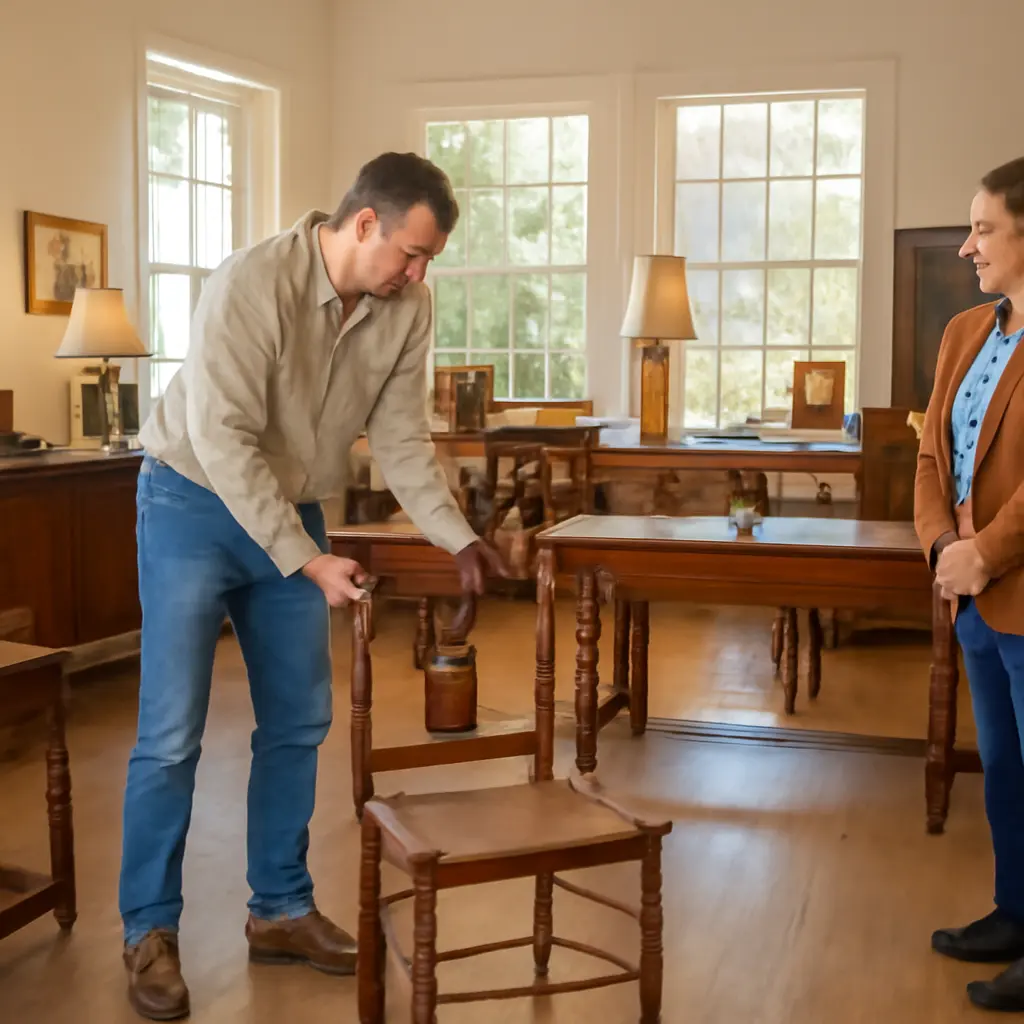
With permission, gently test a chair or table for movement; do not rock, pull, or force a fragile item. Look for legs that sit evenly and drawers that move without binding. If a piece wobbles, has a cracked load-bearing member, or feels unstable, price it as a repair project until a qualified furniture restorer has assessed it.
Read the finish without damaging it
A finish is the coating or surface treatment applied to wood, metal, or another material. Check for uneven gloss, thick paint over detailed edges, finish pooling in corners, and stark differences between visible and hidden surfaces. These clues can suggest refinishing, but they cannot identify a finish or establish a date on their own.
Avoid scraping, sanding, applying solvents, or using a “scratch test” at a sale. Such tests can cause irreversible damage and may violate sale rules. The National Park Service advises preventive care and thoughtful handling of collections; when a finish’s age or composition matters, consult a furniture conservator rather than experimenting.
Look underneath, inside, and behind
Hidden areas can reveal construction and repair history. If the seller permits, inspect the underside of a table, the back of a cabinet, the inside of a drawer, and the rear of a chair. Compare wood, fasteners, tool marks, and finish across the object. A replaced panel or drawer bottom may be entirely reasonable, but differences can help identify later alterations.
Do not rely on one supposed dating clue, such as a nail type or a machine-made cut. Furniture may contain parts from different periods, and later repairs can introduce newer materials into an older piece. Compare several clues and seek specialist advice for high-value or historically significant furniture.
Evaluate restored ceramics, glass, metal, and decorative objects
Small decorative objects can conceal repairs under paint, glaze, plating, or decorative mounts. Restoration may be appropriate for display or use, but it can affect value, stability, and future care. Because different materials require different treatment, a repair that suits one object may be unsuitable for another.
Ceramics and glass: inspect joins and light reflections
A repaired ceramic or glass object may show a fine seam, a change in surface texture, a different sheen, or a small area of repainting. Under good light, rotate the object slowly and inspect the rim, handle attachments, base, and any decorated area. A repair can be carefully matched and difficult to see, so appearance alone cannot confirm that an object is unrepaired.
Do not tap, flex, or wash a questionable piece to test it. Ask whether it has been glued, filled, repainted, or reconstructed, and whether the repair affects food safety or ordinary handling. For an object attributed to a particular maker or period, request documentation and consider an independent specialist’s opinion before paying a premium.
Metalwork: distinguish repair from replacement
On metal objects, inspect soldered joins, patches, replacement handles, plating, and areas of corrosion. A color or surface difference may signal a repair, but it can also reflect wear or an original difference in materials. Do not polish an item to investigate it: polishing can remove a historic surface and change its appearance.
If a metal piece has a loose component, sharp edge, flaking coating, or uncertain contents, handle it cautiously and ask the seller before moving it. The National Park Service’s conservation guidance favors suitable handling and preventive care; unusual, fragile, or potentially hazardous objects are best assessed by a conservator or relevant specialist.
Ask the seller focused questions and assess evidence
A useful description of restoration identifies the work, its approximate date, and the person or business responsible. “Professionally restored” is less informative without a receipt, written treatment record, or details of the materials used. Estate-sale sellers may have inherited the item and may not know its history, so an honest “unknown” is more useful than unsupported certainty.
Questions that clarify a restoration claim
- What exactly was repaired, replaced, cleaned, or refinished?
- When was the work done, and who performed it?
- Are there receipts, photographs, appraisals, or treatment notes?
- Were original parts retained, and are replaced parts available?
- Has the object been exposed to smoke, water, pests, or major temperature changes?
- Are there known structural, electrical, or safety issues?
Photograph the object and any visible repairs if photography is allowed. Keep the seller’s description and any available paperwork with your purchase records. Documentation supports a claim but does not independently prove age, authorship, or quality; compare it with the object and seek independent verification when the stakes justify it.
Decide what to buy, what to investigate, and what to leave
The right decision depends on intended use, budget, condition, and confidence in the object’s history. A repaired everyday table may be a worthwhile purchase even if its finish is later. A rare piece sold as original deserves more stringent evidence. Price should reflect uncertainty, repair costs, and the possibility that a hidden defect will emerge.
Use a simple three-level inspection
- Low concern: Minor, disclosed repairs; stable construction; no obvious missing parts. Buy if the condition and price suit your needs.
- Needs verification: Unexplained finish changes, patched areas, replaced components, or a valuable maker or period claim. Ask questions and seek expert advice before treating the claim as fact.
- High concern: Serious instability, active cracking, loose fragments, strong chemical odors, suspected pests, or unsafe wiring. Avoid handling or using it until a qualified professional evaluates it.
This is a practical screening method, not a professional condition report. For an expensive purchase, obtain an independent appraisal or specialist inspection. The Appraisers Association of America and the International Society of Appraisers provide directories and professional resources; an appraiser can address value, while a conservator can advise on material condition and treatment.
Conclusion: buy informed, preserve what makes the piece matter
Authentic restoration is best judged through a combination of construction, materials, visible condition, documentation, and honest disclosure. Distinguish repair from refinishing and reproduction; inspect furniture and decorative objects without testing or cleaning them; and ask who did what, when, and with which materials. When the object is valuable, fragile, or safety-sensitive, get qualified advice before purchase or use.
At your next estate sale, take clear photographs where permitted, note what the seller can and cannot verify, and compare the asking price with the cost and uncertainty of future work. For further reading, consult the National Park Service’s museum conservation resources and the American Institute for Conservation’s guidance on caring for collections.
Sources: National Park Service, Museum Handbook, Part I: Museum Collections, https://www.nps.gov/subjects/museums/museum-handbook.htm; National Park Service, Conserve O Grams, https://www.nps.gov/museum/publications/conserveogram/cons_toc.html; American Institute for Conservation, Code of Ethics and Guidelines for Practice, https://www.culturalheritage.org/about-conservation/code-of-ethics; Smithsonian Museum Conservation Institute, Caring for Your Furniture, https://mci.si.edu/caring-your-furniture; Appraisers Association of America, Find an Appraiser, https://www.appraisersassociation.org/find-an-appraiser; International Society of Appraisers, Find an Appraiser, https://www.isa-appraisers.org/find-an-appraiser